Is Nvidia halal in 2026? AAOIFI screen + live API verdict
Is Nvidia halal? The AAOIFI screen, the financial ratios, and the live verdict from the Akinda API for NVDA.
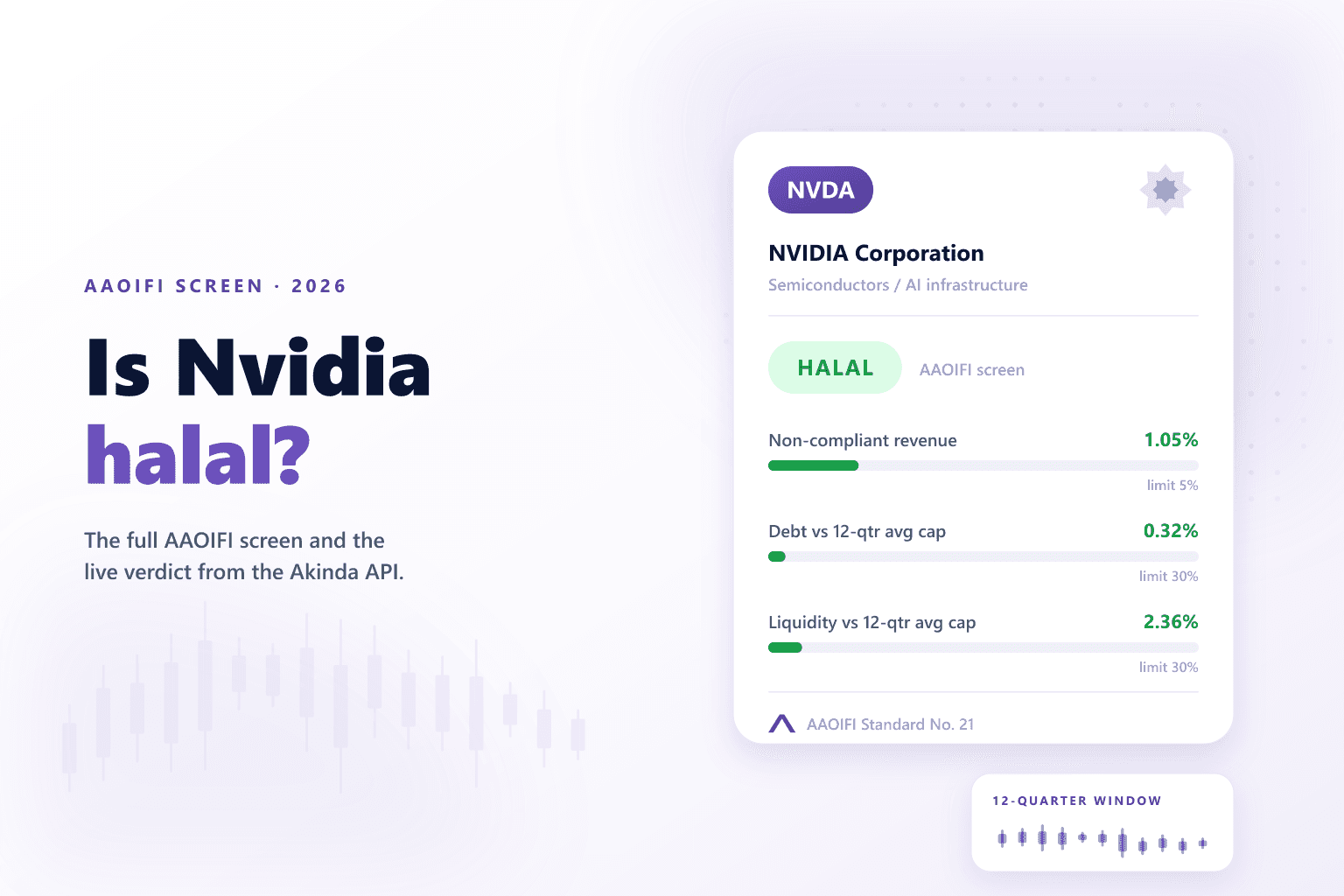
Current verdict: Halal
Company snapshot
NVIDIA Corporation trades under the ticker NVDA and operates in the Semiconductors / AI infrastructure sector. The Akinda API runs every ticker through the same three-phase screen — business activity, financial ratios, and a final verdict — so the verdict above traces back to the numbers below.
Phase 1: Business activity screen
First we check what NVIDIA Corporation actually does. The AAOIFI rule for mixed-business companies says non-compliant revenue must stay below 5% of total revenue, with no exposure to outright-prohibited sectors (alcohol, conventional banking and insurance, gambling, tobacco, pork, weapons, adult content).
- Data Center — GPUs, networking, AI software. Permissible.
- Gaming — GeForce GPUs. Permissible.
- Professional Visualization — Quadro, RTX workstation. Permissible.
- Automotive — DRIVE platform. Permissible.
Non-compliant revenue percentage on /full-report/NVDA: 1.05%. Field name on the wire: non_compliant_revenue_perc.
Phase 2: Financial ratio screen
After the business activity screen clears, the strict AAOIFI grid we apply requires two financial ratios — debt and liquidity / interest-bearing cash position — each below 30% of the company's average 12-quarter market capitalization. Numbers below are the most recent values returned by /full-report/NVDA.
Debt ratio (< 30%)
0.32%
debt_ratio_perc
Liquidity (< 30%)
2.36%
liquidity_ratio_perc
Verify it yourself via the Akinda API
Fire a live /full-report/<ticker> call from the playground using your own API key — see the compliance ratios, AAOIFI screen verdict, and source-breakdown fields the methodology produces.
Related reading