AAOIFI vs IFSB vs S&P Shariah: which screening standard fits your platform?
Three major Shariah screening standards dominate the 2026 fintech landscape: AAOIFI, IFSB, and S&P Shariah. Here's how they differ and which one to use when.
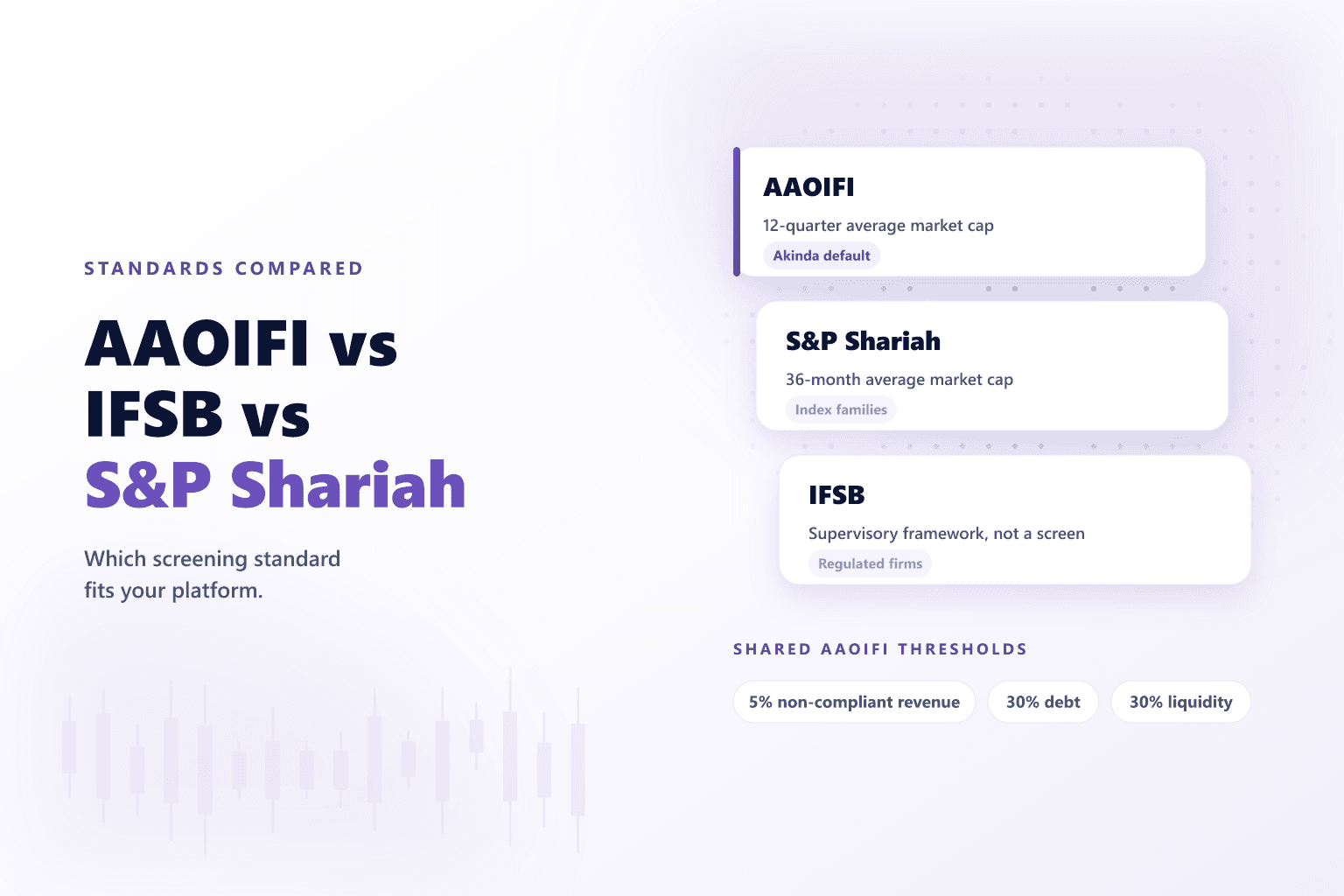
If you're building a halal-investing product in 2026, there are three Shariah screening standards you'll probably end up evaluating: AAOIFI, IFSB, and the family of index-provider standards (S&P Shariah, Dow Jones Islamic, FTSE Shariah, MSCI Islamic). This post summarises what each one actually covers, where they diverge, and how to pick.
AAOIFI
AAOIFI — the Accounting and Auditing Organization for Islamic Financial Institutions — is the standards body whose Sharia Standards form the most-cited reference for Islamic finance worldwide. Standard 21 (Financial Papers) is the load-bearing one for equity screening; it sets the classical screening thresholds you'll see quoted everywhere: 5% for non-compliant revenue, 30% for debt, 30% for interest-bearing investments, 67% for liquidity (receivables / total assets). Most halal-investing platforms today — including the Akinda API — apply the stricter modern reading that collapses the cash-side checks into a single 30% liquidity ratio against avg 12-quarter market cap, aligned with how DJIM / S&P Shariah indices score the same companies.
Pick AAOIFI when your platform serves a general Muslim-investor audience and you want the broadest regional acceptability for your screen.
IFSB
The Islamic Financial Services Board (IFSB) is a regulatory standards-setter — it publishes prudential and supervisory standards for Islamic banks, takaful, and capital markets. IFSB is closer to Basel than it is to AAOIFI: it cares about systemic risk and supervisory framing, not the exact revenue-percentage thresholds for individual stock screening.
Pick IFSB when your platform is being regulated as an Islamic financial institution and your compliance team needs to align with a supervisory framework rather than a screening rulebook.
Index-provider standards (S&P Shariah, DJIM, FTSE, MSCI)
The big four index providers each maintain a Shariah methodology aligned with their index families. They use the same business-activity prohibitions you'll find in AAOIFI, but the financial ratio denominators vary — S&P Shariah uses 36-month average market cap as its denominator, while AAOIFI uses 12-quarter market cap. Small but real differences that change which mid-cap names pass.
Pick an index-provider standard when you're launching an index-tracking ETF or fund product that needs to map back to one of their licensed indices.
Where the standards actually disagree
- Denominator for financial ratios — AAOIFI uses 12-quarter average market cap; S&P Shariah uses 36-month average; some scholars use 24-month or book-value. The same company can pass under one and fail under another.
- Non-compliant revenue threshold — AAOIFI and most index providers settle at 5%; some boards use 10% for “incidental” non-compliant revenue.
- Purification methodology — AAOIFI requires dividend-level purification; index providers often handle it at the fund level instead.
What Akinda runs by default
The Akinda API ships with the AAOIFI-aligned methodology documented in detail on the methodology page. Enterprise customers can request alternative thresholds or denominators (for example, switching to the S&P Shariah 36-month market-cap denominator) — the underlying field set stays the same.
Verify it yourself via the Akinda API
Fire a live /full-report/<ticker> call from the playground using your own API key — see the compliance ratios, AAOIFI screen verdict, and source-breakdown fields the methodology produces.
Related reading